
Written by: A B Acker.
Published: Guitarmaker 91 Spring 2015
One morning I received an email about a product evaluation for publication in Guitarmaker. I read the description of this product with interest. It supposedly was very effective for gluing difficult woods like Teak and Cedar. I had this product sent to me for review.
Most adhesives, even epoxy adhesives, do not bond hardwoods because the saps and resins in the wood interfere with the bonding chemistry of the adhesive. Oak and Teak Epoxy Glue™ is specially formulated by chemists to overcome this difficulty. We designed a chemical system that absorbs and displaces the saps and resins without becoming weakened by the absorbed oils.
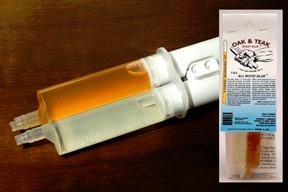
When the Oak & Teak Epoxy Glue™ arrived it was in two attached tubes with plungers in the epoxy and hardener sides. It had a stopper that I had to clip-off, exposing the open ends of the tubes. I then snapped the stopper, which is attached to the assembly, and twists-off, to the ends, sealing them.
I read the instructions and tried attaching some scraps of Oak with the epoxy. I used a piece of heavy card stock to mix the two parts together on another piece of card stock. The instructions emphasize mixing the squeezed-out very thoroughly, and to be certain to mix even the remote part of the puddle together. The epoxy is mixed in the proper proportion automatically as it’s plunged-out. There’s no real hurry in mixing the epoxy because it has a long pot life. You’ll have at least 30 minutes at 85 degrees F. before things start “gelling.” At 85 degrees F. It will be dry to the touch in 3 hours. The manufacturer claims that the mix will set down to 28 degrees F. in about 2 days. You’d want to leave this overnight for it to reach a fully hardened state, even in a 70 degree shop.
When I unclamped the oak pieces they were really fixed together! The wood broke before the bond, which never broke. I notice that the squeezed-out epoxy was fully hardened, but still felt tacky to my fingertip. This disappeared over the next day. This was just a natural progression of the epoxy as my shop is normally 65-67 degrees, so it was still reaching full hardness. Even at this point (when it’s when I tested it) it wouldn’t give-up its joint! So, it was in full strength, just sticky to the touch. I tried Oak and some Western Red Cedar clapboard I had around, and the joint was just as strong on those! There’s no Teak in the shop, so that was the extent of wood clamping tests. It seemed to do fine for these applications. This epoxy deals with “oily” species by combining with these cells, as it’s formulated from much of the same material that usually prevents standard epoxy from adhering to dissimilar species, or to the same species. One of the keys to good adhesion is the complete mixing of the two parts. The mix turns to an amber mix that retains its color after setting, and perhaps even gets deep amber after absolute setting occurs. This would not be too noticeable in a thin glue line, but could be objectionable in light woods. Nevertheless, this will glue species that would not even glue-up well otherwise, so the trade-off is perhaps worth it.
I’d been in touch with Steve Smith, the manufacturer, about people he knew who had used it. He mentioned a few satisfied users, and two especially, who said they used it very exclusively, and for just about every application:
This is a statement from Stim Wilcox, a Bowyer: “I use Oak and Teak Epoxy for gluing southwest ironwood or true rosewood onto Osage orange handle overlays and for bow tip overlays — gluing water buffalo horn onto Osage, and for splicing billets (each billet = 1/2 a bow) into bows. For a more unusual application, I use Clear Penetrating Epoxy and Oak and Teak Epoxy for bow bandages. Bandages are layers of sinew, glued on the bow where there is a problem in the back of the bow, as in pin knots, etc. The Penetrating Epoxy is useful in gluing wet sinew onto the wood, after which I use the Oak and Teak, to further lock the sinew in. You’re probably aware of the problems sinew has when it gets wet, and these glues permanently seal sinew from moisture.
All these applications are gluing other oily woods, plus horn and sinew, on to oily Osage — as well as other oily woods, especially Yew. I find Oak and Teak extremely effective for how I use it, and for most other gluing products I do around my house, etc., which there are many, including gluing stuff in boats etc. As we live on the ocean shore. I’m also amazed at the very long shelf life of your glues.
The only reason I use other glues is the simple expense of Oak and Teak for some bigger projects or for an application where greater heat tolerance is needed.
I don’t use the glue to make glass-laminated bows (which I don’t make), although I think it would be a superior glue for that purpose.”
Michael Tobias, a bass Luthier, mailed me a statement for the review: “I will use it for gluing on fingerboards of all flavors to all flavors of necks. It provides an extremely durable bond, and a great moisture barrier, that I think helps keep the necks more stable. We also use it for gluing tops on body blanks. It is really fine for the exotic woods we use.” That’s a pretty good statement about this epoxy, and should be all I need, but, there’s more.
I’ve wanted to do some vacuum clamping in my shop, and I read an article by Kenneth Michael on the Internet, that mentioned simple vacuum clamping using 10 mil vinyl from JoAnn’s Fabrics™, and suggested using an adhesive that would bond the vinyl to the wood frame. It said to use something other than Duco™ cement, as it wouldn’t bond it together. So, I decided to take some of the epoxy I was testing, and use it in this application. It bonded the vinyl to the Baltic Birch™ very nicely, and I’ve been using this simple fixture to glue guitar braces. It is used in conjunction with stick-on seal, which is available from Home Depot™. So this makes a good addition for a luthier’s shop. But, there’s more yet.
We have an under-counter toaster oven that is a replacement for a previous model from the same manufacturer. The previous toaster oven had one side of its door come loose from the glass. The replacement had its door part from the steel-toglass application at the same spot. This appliance is no longer available, and everything works fine. So I figured what the heck, and tried bonding the metal frame and glass together with the Oak & Teak Epoxy. I clamped it lightly, to keep everything in place, and the next day, it was bonded! The bond only got better with heat from the oven, and it’s still working great every day. If the other side of the door comes loose I’ll glue it together. In the claim on the packaging it says that it will glue glass, metals, rubber and plastic to other materials. I’d thought this was just hype, but I learned it’s not.
There are a variety of products offered at Smith & Co., that range from restoration products to color-coatings for architectural applications. Smith & Co. has a very diversified line of products.
This all leads to my very obvious recommendation for this glue. The only caution that I can pass along it to make sure you mix the two parts very thoroughly. It will do its part if you follow the directions. Oak & Teak Epoxy will work well in your shop, for bonding difficult woods, or dissimilar materials. Give it a try!
Guitarmaker 91 Spring 2015
Copyright THE ASSOCIATION OF STRINGED INSTRUMENT ARTISANS